



Babelfish launches Peoplenomics: four people-first policies, modelled by NIESR and CEBR, that could add £36bn to UK GDP and cut inflation. Put people first.
£1 in Donations Returns £1,294 in Public Contracts
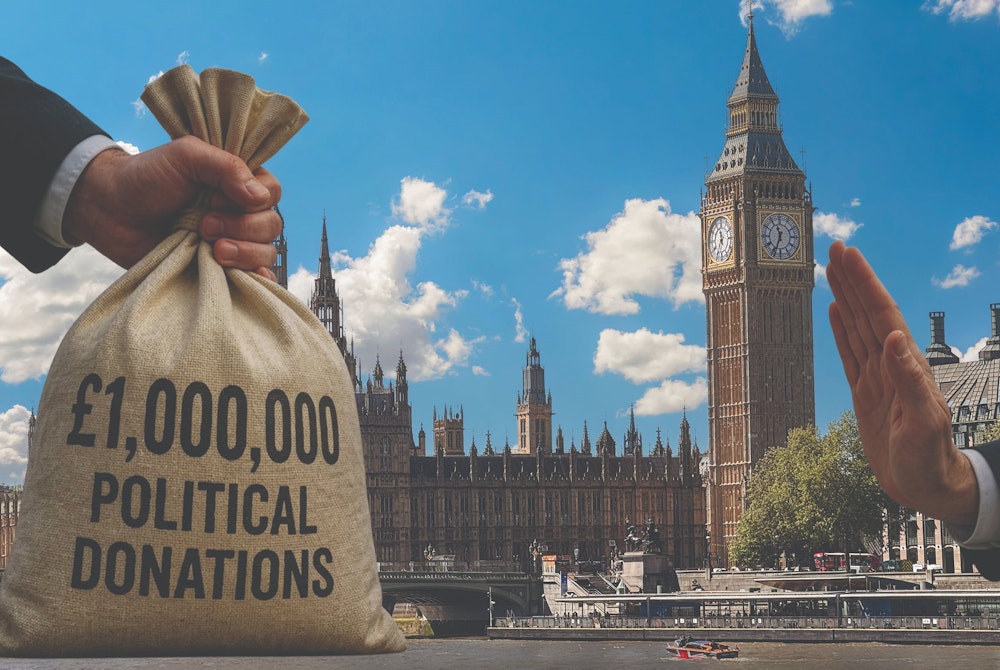
For every £1 donated to UK parties, donor firms get £1,294 back in government contracts. The Autonomy Institute's plan ends private money and rebuilds public trust.
Withprivate money pouring into British democracy, it's no wonder the public has stopped believing in it.
We have a political funding model that allows private wealth to purchase access, influence and, most likely, policy.
At the Autonomy Institute we have built the most comprehensive picture yet assembled of who funds UK political parties, how much they give and what they appear to get in return. This research all points in the same direction: the era of private funding must end.
As political theorist Samuel Bagg notes, democracy relies on preventing the capture of our governing institutions by elite groups. Yet under the present rules, wealthy individuals and corporations can pour vast sums into politics.
Our research has documented 373 companies that sit on both sides of this exchange: donating to parties while receiving public contracts. For every £1 these "giver and taker" firms have donated since 2000, over £1,294 of public funds has flowed back to them in the form of government contracts. This is not a coincidence but rather a structural incentive baked into the system.
Our most recent analysis showed that Labour's business donations surged by 1,707% between the 2019 and 2024 pre-election periods, rising from under £1million to over £14million.
Elimination
But it is not a problem confined to just one party: corporate funding's share of all pre-election finance reached 29% in 2024, the highest level this century. The gravitational pull of private money is distorting both Labour and the Conservatives – not to mention Reform UK's rocketing income from its multimillionaire friends.
Tinkering with the transparency requirements is no longer sufficient. What is needed is a clean break: the elimination of private donations to political parties, replaced by a fair and transparent system of public funding.
Slashing the financial incentive would do three key things: it would dampen, or destroy, any informal agreements between donors and political parties, breaking the links of corruption; it would force parties to broaden their appeal in order to accrue a wider base of paid members; and most importantly it would be a clear signal to the public that their politicians are no longer being bought off.
A predictable objection to public funding is that it is politically unviable: the public will never accept "taxpayers' money going to politicians". This objection deserves serious engagement but, ultimately, it does not hold water.
Firstly, the framing is essential. Public opposition to "giving taxpayers' money to politicians" is understandable. But when the same proposition is framed as "removing the ability of corporations and wealthy individuals to buy political influence," public support would be likely to flip dramatically.
France's ban on corporate donations, for instance, was driven by a series of corporate corruption cases. The partial public funding mechanism was presented not as a gift to politicians but as the price of getting private money out. Thus, the political viability of public funding depends entirely on whether it is presented as the cost of cleaning up politics or as a subsidy for politicians.
Secondly, this is not a radical experiment: banning donations is established practice in countries the British public would recognise as democratic peers.
If private donations are to be banned, the replacement must be credible, fair, and resistant to partisan manipulation. I propose a dual-channel model balancing democratic engagement with baseline economic security for the party system.
At the heart of the proposal is a strikingly simple idea: tie every party's annual budget to the size of its democratic membership. The state would pay £50 a year for each paid-up member of any party holding at least one Commons seat – a formula that would provide a decent budget for today's politics, and one that rewards parties for doing the unglamorous work of persuading real people to sign up.
To stop this from quietly hollowing out smaller parties, a "participatory democracy fund" would sit behind it as a backstop, guaranteeing every qualifying party a floor of £3million a year so that no party with a parliamentary foothold is starved out of meaningful political life. And, crucially, membership subscriptions would also remain in place, but capped at a £10 monthly maximum.
This ensures that the lifeblood of party finance flows from a broad democratic base rather than from a handful of well-connected cheque-writers.
At today's membership levels, this model would cost the taxpayer around just over £50million annually, which could be paid for from a ringfenced fund drawn from the Crown Estate.
This is an incredibly low price to pay for cleaner, more engaged politics – we would shift the balance of power drastically overnight, from a small elite to a wider electorate whose political convictions now carry new weight.
£465m to the Tories: What the Research Revealed

Autonomy's programme of work on political donations, spanning three major publications since 2024, has produced a body of evidence that is now unmatched in UK political finance research. Our landmark Politics for Sale report analysed 21 years of Electoral Commission data, cross-referenced with Companies House and Parliamentary records.
It revealed that the Conservative Party received over £465million in donations across the period, that highly regulated industries, finance, gambling, fossil fuels and construction were disproportionately represented among donors, and that 52% of major business donations came from large private companies.
Our Givers and Takers investigation from 2025 then exposed the donor-contractor nexus at the heart of government, identifying 373 companies that both donated to parties and received public contracts.
Nearly 10% of these firms won large government contracts within two years of donating to the party that subsequently held power. Twenty-nine companies donated approximately £11million to the Conservatives and received £2.3billion in contracts during their time in office. The pattern has already begun to replicate under Labour: eight corporations donating over £580,000 received contracts worth £138million within the government's first year.
Finally, Labour, the Party of Capital? documented how Labour's fundraising base has been structurally transformed, with business donations rising from 2.1% of pre-election finances in 2019 to 22.3% in 2024.
This is not merely a Labour story: it demonstrates that the problem is systemic rather than partisan. Any party that governs will face the same gravitational pull toward corporate money. The only durable solution is to strictly limit the amount of private money in the system entirely.

Other relevant stories

End £30bn bank benefits, tax wealth like work, break the gas price link, launch a rooftop solar revolution and build 1.4m homes. Peoplenomics in five steps.

From King John's 1203 wool tax to the poll tax that sparked riots, 800 years of UK tax history show unfair taxes provoke revolt – and fair ones build nations.

Survation polling finds 59% of Britons back a 2% wealth tax on fortunes over £10m, while 63% say the wealthiest don't pay their fair share. Over to you, Andy.


Peoplenomics: price control, rooftop solar and tax reform put money in people's pockets – and could double UK growth. A new orthodoxy for Burnham's Labour.