



End £30bn bank benefits, tax wealth like work, break the gas price link, launch a rooftop solar revolution and build 1.4m homes. Peoplenomics in five steps.
Solar Panels on UK Council Homes: Just 8% Have Them
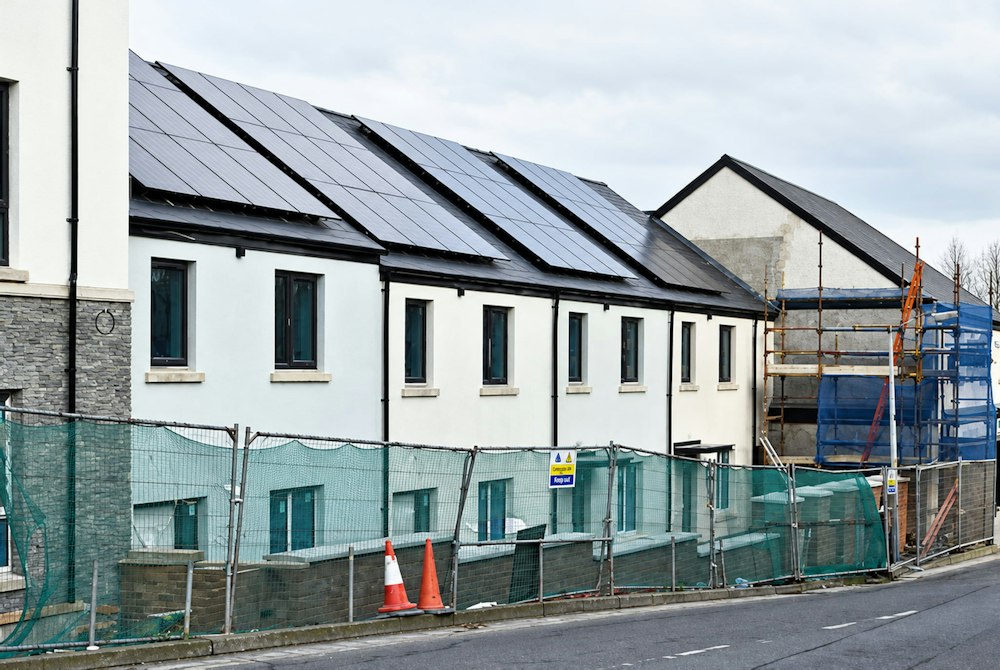
Just 7.7% of council homes in England, Scotland and Wales have solar panels, our investigation finds. At this rate, catching up will take nearly 80 years.
Solar panels are installed on less than 8% of council homes in England, Wales and Scotland, according to an investigation for Babelfish News.
Just two councils have installed solar PV on more than half of their housing stock and at current rates from the last five years it will take the rest of them nearly 80 years to catch up*.
We sent FOI requests to every council which still owns council homes - many transferred theirs to housing associations several years ago.
Responses from 147 councils with 1.2m council homes between them showed that just 92,600 have solar PV - 7.7% of the total.
Our research highlighted wide variations around the country.
Out of 113 councils with a significant stock of 1,000 homes or more, only two, Stirling and Aberdeenshire had solar PV on more than half their council homes.
At the other end of the table, 15 councils - more than one in eight - have solar PV installed on less than 1% of their housing stock.
We also asked councils how many homes had solar installed in each of the last five years.
We were able to use the data we collected to look at how long it will take councils to install solar PV on half of their housing stock. Not all homes are suitable, and blocks where council tenants may share communal areas with right-to-buy leasehold tenants are particularly complex.
Ten councils told us they had installed no solar PV in any of the last five years. Unsurprisingly, they also tended to have lower rates of solar PV in general, with the exception of Babergh and Mid Suffolk District Council, which said it had installed panels on nearly 30% of its housing stock but all more than five years ago.
Of the rest in the middle, more than 100 councils across England, Scotland and Wales, we found that at the rate of progress of the last five years, it would take them on average around 90 years to get to 50% from where they are currently**.
Just six councils are on track to get to 50% in the next decade, based on the rate they have been installing solar over the last five years. They are Colchester, North Ayrshire, Exeter, North Kesteven, Wealden and Oldham.
There are signs of encouragement in our data. The number of council homes with new solar PV installed has increased every year since 2022. Across 113 councils where we have data, installations have risen steadily from 5,843 in 2022/23 to 8,758 in 2025/26, an increase of 50%.
But even at this increased rate, it will take more than 50 years to hit the target of solar panels on 50% of council homes***. 24 councils - more than one in five - told us they installed no new solar PV last year.
Not all solar PV directly benefits council tenants.
Haringey Council told us it has installed solar on 1,609 out of 20,455 council homes. But most - 1,491 - are "flats where the solar PV feeds into the landlord supply", contributing to the communal electricity supply and powering equipment such as stairwell lighting, door entry systems and lifts.
Some of the best:
Aberdeenshire Council - has 13,467 council homes (9266 houses and 4201 flats) and 10,496 of them (78%) have solar PV, including 3983 in the last five years
A spokesperson said the council began installing solar PV in 2015 "driven by our commitment to helping tenants save money on their energy bills and reducing our carbon footprint".
They added: "We have faced challenges in installing photovoltaic systems in certain areas due to constraints with the national grid. These issues cannot be resolved until the infrastructure is upgraded.
"This has limited our ability to expand PV installations in some regions, impacting our efforts to provide energy savings and sustainability benefits to all tenants. Additionally, we have mixed-tenure flats, and we need to consider solutions for collaborating with owner-occupiers and sharing roof space.
"Although Aberdeenshire is not known for its hours of sunshine, we are confident that the installed PV systems can help tenants save money."
Exeter City Council - 4724 council homes (2,202 houses and 2,522 flats) and has installed solar PV on 1,136 (24%) of them. It includes 909 installations in the last five years.
A Council spokesperson said that, "following the city's declaration of a climate emergency" in 2019, it has planned a "route for the city to meet carbon neutrality by 2030". Installing Solar PV is one of a number of measures being undertaken.
The spokesperson added: "Exeter City Council's principal driver has been to maximise roof capacity where possible, this is to help tenants with rising energy costs and to decarbonise our housing and corporate stock.
"The biggest hurdle has been with connection to the national grid and restrictions being placed on some of the properties as the grid has struggled to upload any surplus supply.
"Exeter City Council has struggled installing PV on some of our ageing housing stock, the technical requirements of installation of PV on older roof structures has not always allowed us to install larger arrays or has come with some prohibitive costs.
"The PV installations that have been funded by government schemes, local authorities and Exeter City Council have been wholly focused on the tenants maximising the use of the energy produced."
Wealden District Council - 3,027 council homes - 664 (22%) with solar PV, incl 516 in the last five years
A council spokesperson said: "Social landlords in England must ensure all their socially rented homes reach an Energy Performance Certificate rating of C or equivalent by 1 April 2030.
"The council takes a fabric first approach to energy efficiency improvement to lower overall energy demand and keep homes comfortable in the first instance.
"The installation of solar PV is then most commonly the next logical step to enable homes to reach an EPC rating of C after insulation measures."
"After the building fabric is secure, solar panels offer one of the most reliable, proven financially viable returns of any renewable home upgrades."
"They are quick and relatively easy to install, easy and low maintenance and offers residents immediate savings on their energy costs."
Funding came from Social Housing Decarbonisation Fund, with the match funding from the council's Housing Revenue Account, and an award from the Warm Homes: Social Housing Fund.
Some of the worst:
Tamworth Borough Council - 4,300 homes and just five with Solar
Councillor Ben Clarke, portfolio holder for housing, homelessness and planning, said: "We know how important energy efficiency is to our tenants, both in reducing their bills and in helping us meet our wider environmental goals. Like many councils, our housing budget is limited, and our priority has rightly been to ensure every council home meets decency and compliance standards first.
"Our approach so far has focused on 'fabric first' improvements such as insulation and other measures that reduce heat loss, which address energy efficiency at its foundation. Going forward, we are working to identify accessible funding to further improve the energy efficiency of our homes.
"We remain committed to ensuring our housing stock is warm, efficient and fit for the future, within the resources available to us."
Medway Council - 3,031 council homes and just nine with solar
A Medway Council spokesperson said: "There are a number of reasons why we have a low number of solar panels installed on our older properties.
"One significant factor is that we have carried out extensive work in other areas to lower carbon emissions and improve efficiency.
"Our immediate priority is to improve the building fabric first, for example, installing insulation and undertaking measures to reduce heat loss.
"Most of our homes are heated by gas, so while solar PV would reduce electricity use, it would not substantially reduce the energy used for space heating and hot water – although we are looking to progressively replace gas boilers with electric heat pumps from around 2034 onwards.
"Solar PV is not suitable for every home. We also need to consider the condition and remaining life of each roof.
"While panel prices have reduced, a complete installation still involves significant cost. PV can help improve a home's EPC rating, particularly where a property is close to the next band, but it is only one of several measures available."
* This is based on the 113 councils who responded to say they had 1,166,974 council homes and 90,117 of them had solar panels. Excluding the top two who already have 50% of homes with solar PV, leaves 111 councils with 1,147,213 council homes and 74,156 with solar PV. They need 499,450 more installations to cover 50%. These councils installed solar on 32,091 of homes in the last five years. At that rate it would take 77.8yrs to hit 50%.
** This looks at the 113 councils but takes out the two that already have 50% and also the ten that installed no solar in the last five years (as it would take them forever to reach 50%). Of the remaining 101 councils, we looked at the average. The mean is over 300 but the median, used here, is Great Yarmouth where we have calculated it would take 87.4yrs to reach 50%.
*** This repeats the calculation of done for par 2 (*) but instead of using the five year installation figures only uses the 2025/26 figure of 8,758 installations. That suggests 57 years to reach 50%.

Other relevant stories

Putting solar on 1.8m UK social homes would save households £618 a year, add £5.1bn to the economy and support 7,600 jobs a year, new CEBR modelling shows.

Housing associations sold 5,250 homes in 2024-25 as 1.3m households sat on waiting lists. Councils want first refusal to buy them back before they're lost.

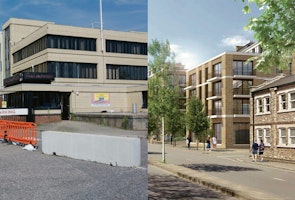
Mortlake's Stag Brewery site has permission for 1,000+ homes, yet it's been 'mothballed'. As UK housebuilding hits a 10-year low, why are we still waiting?

Public brownfield land could take 215,000 UK homes, with 176,000 more on mixed sites – a quarter of Labour's housing target. So why is building still so slow?