



Babelfish launches Peoplenomics: four people-first policies, modelled by NIESR and CEBR, that could add £36bn to UK GDP and cut inflation. Put people first.
UK Tax Loopholes: The Billions Burnham Could Claw Back

Lord Sikka sets out how PM Andy Burnham can raise billions within Labour's fiscal rules – from ending bank subsidies to taxing capital gains like wages.
How to pave the way for a fairer society
Andy Burnham, the UK's seventh Prime Minister in just over a decade, has inherited an economy ravaged by neoliberalism.
Some 25.3million people, including 14.9million working adults and 7.7million children, live below minimum income standards. The poorest 20% pay a higher proportion of their income in direct and indirect taxes than the richest 20%.
Workers' share of gross value added has declined from 71.9% in 1975, to 59% now; 6.16million individuals await 7.28million hospital appointments in England. There is a dearth of new hospitals; 1.3million households (about four million people) are on a waiting list for a social home but only 12,198 social homes a year are being built.
Social care is in disarray. Universities are in financial crisis. Roads are potholed. Half of England's schools are unfit for use.
The court system is creaking and prisons are overflowing. The economy is vulnerable as manufacturing has declined from 30.1% of economic output in 1970 to 8.5% by 2026.
Arbitrary fiscal rules prevent the state from investing in public goods. Consequently, the UK has languished at or near the bottom of the G7 and OECD league of investment in productive assets for over 30 years, resulting in low productivity. Burnham needs resources to recalibrate society and deliver promised reindustrialisation, defence spending, public ownership of essential industries, investment in infrastructure, social housing and more.
He could embrace the Modern Monetary Theory and create new money for economic revival but is unlikely to. He could increase tax rates but has pledged to stick to Labour's 2024 manifesto, which promised to not increase national insurance, marginal rates of income tax, VAT and corporation tax rate.
He has also promised to stick to the existing fiscal rules that restrict government borrowing. Even with self-imposed constraints, Burnham has considerable opportunities for generating resources to build an equitable society. Here are some examples:
Since 2006, the Bank of England has paid interest on central bank reserve deposits to commercial banks. Central bank reserves are deposits held by commercial banks at the Bank of England (BoE) and are used to settle payments between banks. They are also used by the BoE to manage interest rates through tools such as quantitative easing.
The interest payments accelerated in 2009 as quantitative easing took hold. As interest rates rose, payments to commercial banks increased alongside.
The EU had similar arrangements but in 2023 virtually eliminated the practice, saving about £5.2billion a year. The Swiss central bank also stopped paying interest on minimum reserves. The UK continues to pay massive amounts in interest: £38.23bn in 2023, £36.33bn in 2024 and £25.9bn in 2025.
Billions can be freed up by ending this hidden subsidy to banks.
Dividend
Wages are taxed at marginal rates of 20%-45%. Earners also pay national insurance. Capital gains above £3,000 are taxed at marginal rates of 18% to 24%. By taxing capital gains at the same rates as wages, around £12bn to £14bn could be raised. More, if national insurance is levied.
Dividends above £500 are taxed at marginal rates of 8.75%, 33.75% and 39.35%. Bringing dividend taxes in line with income tax rates could raise £6bn a year. Higher if national insurance is also charged.
Gross tax relief on pension contributions to employers and employees in 2024-2025 was £83.9bn. Some 14% of the tax relief benefited 1.1million additional-rate (45%) taxpayers, 57% benefited 6.6million higher-rate (40%) taxpayers and 29% benefited 30.4million basic-rate (20%) taxpayers. By restricting tax relief at 20% to all, the government could keep £14.5bn.
Dividends to foreign investors are paid without deducting tax at source. In principle, foreign investors would pay tax at their place of domicile but dividends may be paid to vehicles in offshore tax havens which do not levy tax on foreign incomes.
Subject to various tax treaties, the US, Australia and Sweden have a dividend withholding tax rate of 30%, Italy 26% Germany, and Canada and France have 25%. The UK should follow suit.
Corporate employers pay national insurance contributions on director salary. In partnerships and limited liability partnerships (LLPs) employers pay national insurance on employee earnings, just like companies. However, partners receive a share of profit instead of a salary and are treated as self-employed. Self-employment status means partnerships and LLPs do not pay Employers' National Insurance (ENI) on partners' share of profits. This enables ENI avoidance. LLPs dodge £150,000 ENI per £1m profit shared. Big-four law firms alone reportedly avoided paying £4bn of ENI.
There is considerable potential to collect additional ENI from lawyers, accountants, dentists, surveyors and architects trading through partnership structures.
A 1% tax on share buybacks by FTSE-listed companies could on average raise £225m a year. Recently, companies such as BP and Shell have handed billions to shareholders through buybacks. The companies were subject to a windfall tax of around 25% on profits. If share buybacks for Shell and BP were subjected to the same 25% rate this could have raised £11bn.
By charging VAT at the standard rate (20%) on private healthcare insurance, government could raise around £2bn a year.
A Financial Transactions Tax on the purchase and sale of financial instruments like shares, bonds, and derivatives could raise £5bn a year. A 2% tax on wealth above £10m could raise £24bn a year.
Over 1,180 tax reliefs worth billions are given to individuals and corporations, but only 380 have been costed by HMRC. Another 189 are being investigated.
Little is known about the economic benefits of most of them. Many are abused.
Due to numerous tax reliefs and profit shifting, few companies pay the main 25% rate of corporation tax. The effective tax rate is about 10% less. A 1% increase in the main rate can generate £3.6bn.
Most financial services are exempt from VAT. Around £8.7bn a year could be raised by charging VAT at the standard rate.
Currently, 8% national insurance is levied on incomes between £12,570 and £50,270, and 2% on incomes beyond that. Around £10bn a year can be raised by extending the 8% rate to all income. Significant amounts can be raised by a graduated rate e.g. 2% on incomes between £50,271 and £100,000; 3% on income between £100,001 and £150,000, and a higher rate on incomes above that.
Failed
Government could reintroduce a 15% investment income surcharge on income exceeding, say, £5,000. This could apply to dividends, rental income, capital gains and more and could generate £18bn a year.
In 2024-25, HMRC failed to collect taxes of £59.2bn, totalling nearly £500bn since 2010. HMRC underestimates tax avoidance by wealthy individuals and does not produce an estimate of taxes lost to offshore excursions. £12.8bn lost through profit shifting by multinationals is not included in the HMRC estimate. Billions can be raised by tackling tax abuse and the industry behind it. The rules applied for curbing tax avoidance don't apply to business rate avoidance.
The total dodged is not known. Millions can be raised by ending abusive schemes.
The Enterprise Act 2002 removed HMRC's preferential creditor status for bankrupt entities. It was partly restored by the Finance Act 2020, but HMRC is still an unsecured creditor for taxes specifically relating to a business (such as corporation tax and capital gains tax). The losses form a significant part of the £5.6bn written off in 2023-24, £7.2bn in 2024-25 and £12.8bn in 2025-26. Restoration of the preferential creditor status can raise billions.
Research shows that since the pandemic corporations have increased profit margins by an average of 30%. Electricity and gas supply companies increased theirs by 363%, often without additional investment or risk.
Governments can raise large amounts via windfall taxes. For example, a windfall tax on the UK's four biggest banks could raise £19bn. A windfall tax is levied on energy companies. Their 2025 profit of £23.1bn is further boosted by the Iran war. There is a scope for higher rates of windfall tax.
Lord Sikka is emeritus professor of accounting at the University of Essex and University of Sheffield

Other relevant stories


End £30bn bank benefits, tax wealth like work, break the gas price link, launch a rooftop solar revolution and build 1.4m homes. Peoplenomics in five steps.

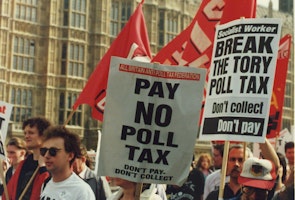
From King John's 1203 wool tax to the poll tax that sparked riots, 800 years of UK tax history show unfair taxes provoke revolt – and fair ones build nations.

Survation polling finds 59% of Britons back a 2% wealth tax on fortunes over £10m, while 63% say the wealthiest don't pay their fair share. Over to you, Andy.


Peoplenomics: price control, rooftop solar and tax reform put money in people's pockets – and could double UK growth. A new orthodoxy for Burnham's Labour.