



End £30bn bank benefits, tax wealth like work, break the gas price link, launch a rooftop solar revolution and build 1.4m homes. Peoplenomics in five steps.
1.4m Homes Are Waiting on Brownfield Land
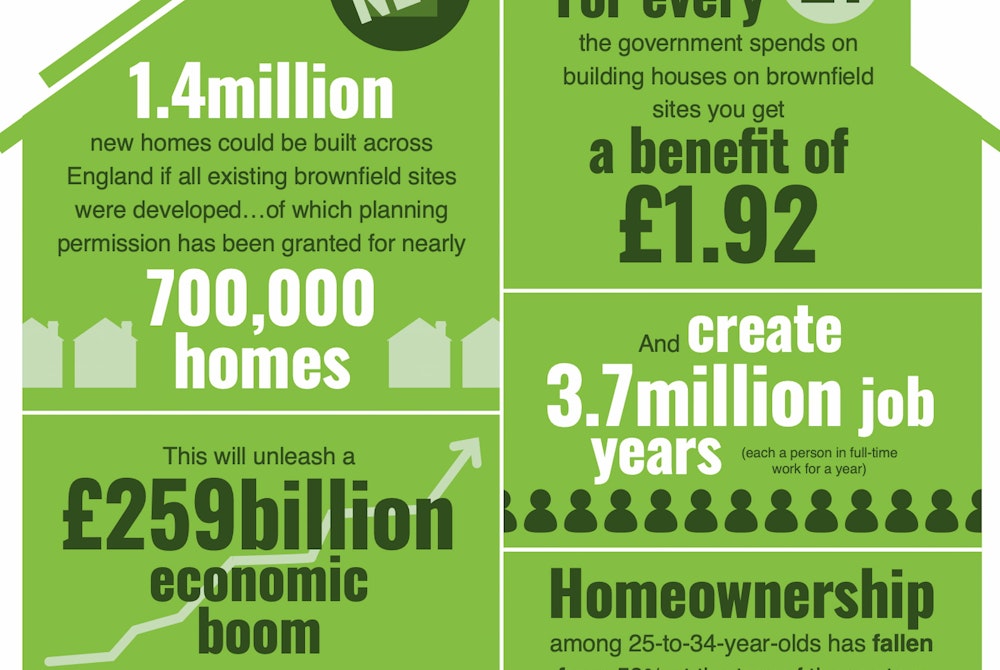
Babelfish commissioned CEBR to map England's brownfield sites. The result: 1.4m homes, £259bn in economic value and 370,000 jobs a year for a decade.
In a political discourse that agrees on almost nothing, the need to build more homes is as close to common ground as it gets.
The right-leaning Policy Exchange calls the housing shortage "a key driver of the UK's weak economic performance", while the centre-left Institute for Public Policy Research reaches the same conclusion. The only real argument is how to do it.
Babelfish commissioned the Centre for Economics and Business Research to assess England's housebuilding potential, focusing specifically on the land that should be least controversial – brownfield sites already identified by local government as suitable for housing-led development.
This sidesteps the green belt, preserves natural habitats and biodiversity, and supports denser, lower-carbon communities. Fully utilised, brownfield sites across the country could support 1.4million new homes, the development of which would generate a £259billion economic impact over the next 10 years.
PERMISSION
The country is littered with old factories, depots, car parks and other brownfield sites lying empty and unloved, victim to fly-tippers and colonies of rats – no matter where you live you will know somewhere nearby that makes you wonder, "Why don't they build on that?"
England's Brownfield Land Register regulations require every local planning authority to publish all such sites assessed as appropriate and available for residential development.
Combining data for every planning authority (unfortunately consistent data is not published for other UK nations), we found enough land for around 1.4 million new homes. Of these about half (a little under 700,000) already have planning permission. Our modelling is based around building all 1.4 million over the next decade.
Homes in each area were split between private market and affordable tenures in line with building patterns over the past five years. Data from previous construction projects was used to assess spending requirements, then integrated into CEBR's economic models.
This captures three layers of economic activity: the building work itself; the suppliers it pulls in (bricks, architects, surveyors etc); and the everyday spending of the workers paid to deliver this work.
The construction work alone is worth £89billion in gross value added over the 10-year delivery timeline (the proper measure of contribution to UK GDP).
Counting the supply chains and worker spending, the development would support £259billion of gross value added and 3.7 million "job-years" (each a person in full-time work for a year). Every £1 of value created through the initial construction supports another £1.92 elsewhere in the UK economy; every construction job sustains a further 1.75 jobs.
On average, the benefit comes to roughly 370,000 jobs and £26billion of added value per year for a decade – a little under 1% of current UK GDP – while also leaving the country 1.4million homes better off.
This will be significant in beginning to tackle the housing crisis. Resolution Foundation found that when adjusted for quality, UK housing is more expensive than any other developed economy. The Institute for Fiscal Studies notes that homeownership among 25-to-34-year-olds has fallen from 59% at the turn of the century to 39%, while ONS data shows that private renters spend more than a third of their income on rent.
And this is far from just a London story. Under this plan, the capital would gain around 374,000 homes and £56billion in gross value added. But because brownfield tends to sit in areas that have historically struggled economically, building it out is regeneration aimed at the places left behind.
The North-West could host 215,000 homes, the West Midlands 189,000; Birmingham alone has space for more than 105,000, and Manchester, Salford and Leeds rank among the biggest opportunities. Together, the Midlands and the North hold nearly two-fifths of the potential additional economic activity. The most deprived tenth of areas in England would host almost a fifth of nationwide economic impact.
So why don't we just get building?
Perfectly sensible building schemes become unviable for all manner of reasons: a slow, under-resourced planning system rooted in the antiquated 1947 Town and Country Planning Act; local opposition; an ageing, under-skilled building workforce that is not large enough; the collapse of small and medium builders from 40% in the late 1980s to barely 10% today; and rising costs.
None of these is trivial to solve. But that is no reason not to try. The land is waiting, let's build on it.

Other relevant stories

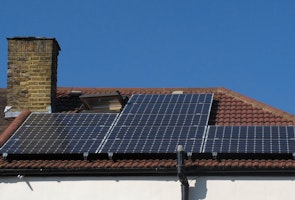
Putting solar on 1.8m UK social homes would save households £618 a year, add £5.1bn to the economy and support 7,600 jobs a year, new CEBR modelling shows.

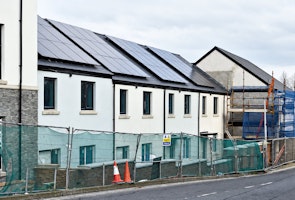
Just 7.7% of council homes in England, Scotland and Wales have solar panels, our investigation finds. At this rate, catching up will take nearly 80 years.


Housing associations sold 5,250 homes in 2024-25 as 1.3m households sat on waiting lists. Councils want first refusal to buy them back before they're lost.

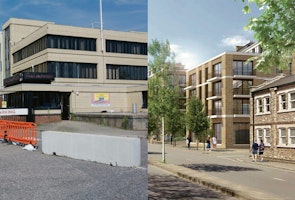
Mortlake's Stag Brewery site has permission for 1,000+ homes, yet it's been 'mothballed'. As UK housebuilding hits a 10-year low, why are we still waiting?