



End £30bn bank benefits, tax wealth like work, break the gas price link, launch a rooftop solar revolution and build 1.4m homes. Peoplenomics in five steps.
Left to rot: Taylor Wimpey's derelict Burton landmark
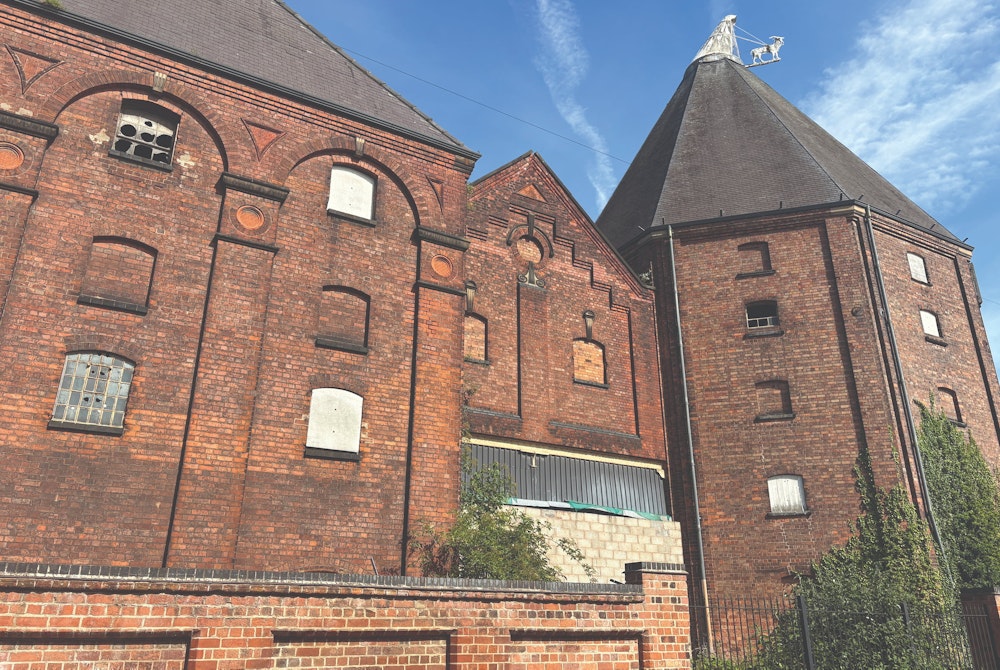
The Goat Maltings has stood derelict for two decades under Taylor Wimpey. Meanwhile 9,766 households wait for social housing in East Staffordshire.
The Goat Maltings is one of Burton upon Trent's most recognisable buildings, with its famous silver Welsh goat proudly surveying the town from the roof of the old brewery.
Often mistaken for a weathervane, it was in fact a vent used for drying the malts during the brewing process, and it has become a much-loved landmark.
But for years the site and the Grade II listed building on which it sits have been left to rot, despite being co-owned by one of Britain's biggest housebuilders, Taylor Wimpey, since the mid-2000s.
While some parts were converted into flats, the main block is untouched. All the windows are boarded up or smashed, and locals say the site is plagued by rats and feral cats.
What was supposed to be a luxury apartment complex is now a sad eyesore, with weeds growing from gutters and ivy creeping up the walls. The entire site is surrounded by barbed wire fencing to prevent antisocial behaviour and further fly-tipping.
Yet Burton is as badly hit by the housing crisis as anywhere. The social housing waiting list for East Staffordshire Council is 9,766 but just 39 new homes came up for affordable or social rent last year.
Ian McLaren, who has lived opposite the maltings on Clarence Street for over 40 years, called it "sad". "It's in a right state," he said. "We can see over the site from our bedroom and it's just weeds and rubbish.
"They had to brick up the entrance to stop kids getting inside and there was a fire a few years back. It would be lovely to see it turned into flats, but they've been saying that for years."
Neighbour and hotel worker Thomas Davies, 39, said: "It's just such a shame that it's being left to rot. If developers buy properties then they should follow through and develop them.
"It's not fair on local residents to just be left looking at an eyesore. The only other option is to flatten the whole thing and build houses.
"While that would solve the problem and create much-needed houses, is that what we really want, to demolish listed buildings?"
Owners Taylor Wimpey and Cameron Homes were given planning permission in 2006 for 61 apartments, though this appears to have lapsed.
In 2019 Cameron Homes told the Staffordshire Live website it would be difficult to convert due to low ceiling heights and small windows that are tricky to change because of its listed status.
Local businessman Mike Cherry, whose family was once involved in running the Goat Maltings, said developers have a responsibility.
Mr Cherry, the former chairman for the Federation of Small Businesses, said: "I'm disappointed that nothing has been done for so long.
"Everyone knows we need more housing, so why does it remain derelict and in an increasingly poor state of repair? It begs the question, why did the developers buy it in the first place?"

Other relevant stories

Putting solar on 1.8m UK social homes would save households £618 a year, add £5.1bn to the economy and support 7,600 jobs a year, new CEBR modelling shows.

Just 7.7% of council homes in England, Scotland and Wales have solar panels, our investigation finds. At this rate, catching up will take nearly 80 years.

Housing associations sold 5,250 homes in 2024-25 as 1.3m households sat on waiting lists. Councils want first refusal to buy them back before they're lost.


Mortlake's Stag Brewery site has permission for 1,000+ homes, yet it's been 'mothballed'. As UK housebuilding hits a 10-year low, why are we still waiting?